


Seize the summer & world.

Summer Programs
General Policy
DKU undergraduate students have the option to pursue credit or non-credit bearing experiences during summer without approval from DKU for participation. DKU does not require summer enrollment, and participation in summer programs is optional and not considered to be studying away.
Students may not enroll in summer courses or programs that conflict with DKU required summer projects (such as Chinese Society and Culture courses), or that overlap with the DKU fall/spring course schedule and academic calendar.
Students are responsible for the full costs of all summer programs, including those at Duke; DKU merit scholarships and/or financial aid cannot be used to cover the cost of summer programs.
Credit Transfer for Summer Programs
For each summer program, students can transfer credits to DKU for no more than a cumulative total of two courses, up to a maximum of 8 credits (subject to the procedure in the Host-DKU credit transfer requirements).
Students wishing to transfer credit for study during the summer must complete and receive approval through the credit-transfer review process. Preapproval for courses is strongly recommended because approval for course transfer is not guaranteed. Transfer credit from Duke or other academic institutions through summer programs will need review and approval from the division chair to fulfill the distributional requirement.
All transferred credits and courses follow policies listed in the DKU Undergraduate Instruction Bulletin. To learn about Host-DKU credit transfer process, please visit the page.
Summer programs provide students not only with the opportunity to delve deeper into their academic interests and scholastic skills and to keep pace with their peers to stay on track to graduate, but also offer chances to enrich their life experiences and forge new connections with the wider world.
Summer programs are optional and students are free to choose any program they are interested in. If you are looking for a summer program but a little lost about where to start, how to identify the good ones, the programs shared with DKU below can be a helpful point of reference.
Note: DKU has no partners with these summer programs. Should you have questions, please check with the program directly.
If you are interested in the Duke Summer Session, please visit the Duke program page.
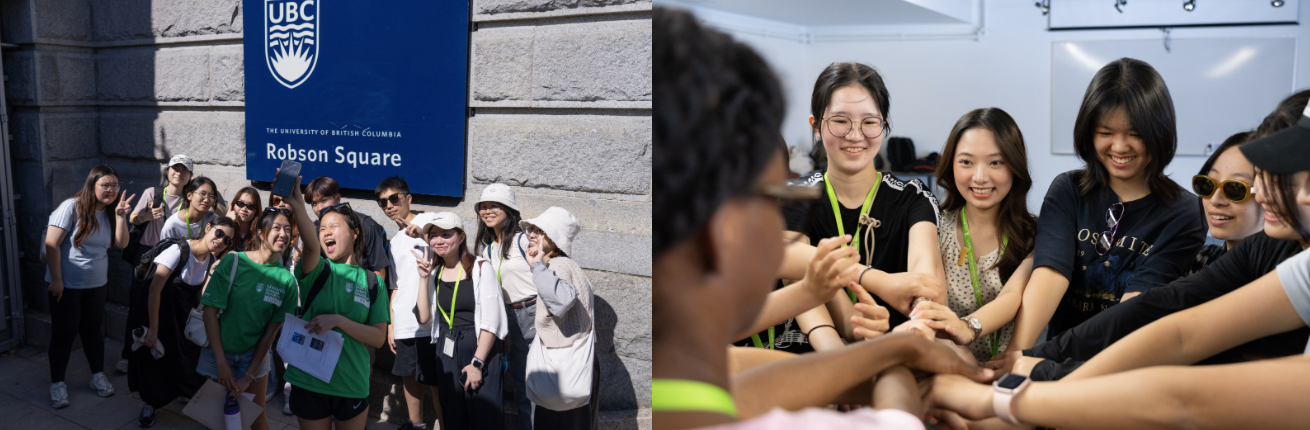
Vancouver Summer Program
University of British Columbia (UBC)
Each summer, VSP welcomes many students from diverse academic and cultural backgrounds to take part in a four-week, immersive learning experience at the University of British Columbia in Vancouver, Canada. Participants choose from our diverse selection of course packages while experiencing life on our beautiful Vancouver campus through sociocultural activities and community events.
VSP offers an extraordinary opportunity for students to broaden their perspectives, develop intercultural skills, and form lasting friendships that extend far beyond the classroom.
- June Session: June 5 – July 5, 2026 (Application deadline: March 13, 2026)
- July Session: July 17 – August 17, 2026 (Application deadline: April 17, 2026)
Website: vancouversummerprogram.ubc.ca
Email: vsp.ubc@ubc.ca
St Andrews Summer Study 2026 Information Session
Interested in studying abroad this summer? Experience a transformative summer at the University of St Andrews through our undergraduate-level Summer Study program. Study for credit while experiencing academic and cultural life at one of the UK’s most historic universities.
Join this free online information session to learn more about St Andrews Summer Study 2026 (registration required).
When: Tuesday 2 December 2025, 5pm (GMT) / 12pm (US Eastern)
What to expect:
- Overview of the program, courses on offer, and application advice
- Hear from Summer Study alumni students
- Live Q&A
Can’t attend live? Register anyway to receive the session recording afterwards to watch at your convenience.
Visit our website to learn more about St Andrews Summer Study or contact the team at shortcourses@st-andrews.ac.uk.
Applications for 2026 are expected to open in late November. Register interest at shortcourses@st-andrews.ac.uk to be notified when applications open.
Oxford Worcester College 2026 Information Session
We are delighted to invite students and professionals to join our Oxford Certificate Programmes here at Worcester College (University of Oxford). Our residential programmes offer academic enrichment through innovative and exciting seminars and lectures, which complement cultural and social activities. Our programmes give all participants the opportunity to learn in an Oxford college setting. All courses are taught by Oxford and Cambridge tutors, and upon completion of the programme, participants receive a Certificate of Attendance and Achievement.
Worcester is one of the historic colleges of the University of Oxford. It was founded in 1714 on the site of previous Oxford colleges dating back to the late 13th century. Although it is very close to the centre of Oxford, Worcester is the only college to have its sports grounds onsite. The college buildings are set in beautifully landscaped gardens, with buildings dating from the medieval period through to the 21st century.
- Session I: July 19-August 1, 2026
- Session II: August 2-August 15, 2026
- (Application deadline: April 15, 2026)
Visit our website to learn more about Oxford Worcester College Summer Study or contact the team at enquiries.cpc@worc.ox.ac.uk or WeChat Ms. Cindy Chen cindychen6228.
Applications for 2027 are expected to open in late November/early December.
Application Deadlines
Vancouver Summer Program (UBC) - June Session
March 13, 2026
Vancouver Summer Program (UBC) - July Session
April 17, 2026
Cultural Heritage Protection & Interactive Narratives through Digital Intelligence Transformation
Wuhan University Summer School 2026
Program Overview
In the context of accelerating global digital transformation and rapid advances in artificial intelligence, cultural heritage protection, research, and heritage storytelling are undergoing a profound shift toward intelligent, data-driven, and immersive modes of practice. This program integrates cutting-edge AI approaches with protection practices to explore new paradigms of public communication and cross-cultural engagement, and to cultivate emerging talents with a global perspective and strong interdisciplinary collaboration skills. As a flagship activity of the 2026 Luojia Global Summer Program (LGSS), this project is specially funded by Wuhan University. Selected participants will take part in an intensive one-week program featuring lectures delivered by world-renowned scholars and professionals, complemented by experiential learning through onsite field visits and guided tours. Scholarships will be provided to admitted applicants, covering all tuition fees, as well as most food and lodging costs.
- Host: Intelligent Computing Laboratory for Cultural Heritage (ICLCH), Wuhan University (WHU)
Website: http://iclch.whu.edu.cn//
Email: iclchiclch@whu.edu.cn
- Brochure-Laboratory Intelligent Computing Laboratory for Cultural Heritage of WHU
Co-organizing Units: School of History, Wuhan University; Archaeological Institute for Yangtze Civilization; State Key Laboratory of Information Engineering in Surveying, Mapping and Remote Sensing
This course builds on the strong disciplinary foundations and research strengths of the Intelligent Computing Laboratory for Cultural Heritage at Wuhan University, together with the School of History, the Archaeological Institute for Yangtze Civilization, and the State Key Laboratory of Information Engineering in Surveying, Mapping and Remote Sensing, in the areas of digital humanities and cultural heritage digitization. By integrating rigorous scholarship, an international perspective, and hands-on training, it aims to cultivate outstanding interdisciplinary talents to meet the needs of digital intelligence transformation in the cultural heritage field. All the courses will be taught in English/French (with machine translation).
- Learning Cutting-Edge International Theories: Leading international experts in cultural heritage will be invited to deliver lectures and engage in academic exchange on frontier topics such as heritage protection and interactive heritage storytelling.
- Sharing Landmark Industry Cases: Industry professionals will present representative practice cases and share insights, helping applicants gain a direct understanding of current applications and development pathways in the field.
- Collaborative, Project-Based Practice: Applicants will be encouraged to work in participatory teams on practical activities such as cultural heritage data acquisition and intelligent interaction design, strengthening their applied skills.
- Digital Intelligence techniques Driven Systematic Protection of Cultural Heritage: This module covers the systematic workflow of heritage protection, including cultural heritage data acquisition, real-time intelligent monitoring, feature extraction of damage, character and image recognition, and AI-assisted restoration. The course will draw on representative Chinese practices such as the Dunhuang Academy and the Palace Museum to demonstrate how digital Intelligence techniques are applied in cultural heritage data collection, monitoring, computation, research, and utilization.
- Interactive Storytelling of Cultural Heritage in the Perspective of Digital Humanities: This module explores the creative frontiers of scenario construction for heritage narratives, the digital interpretation of cultural significance, and the reconstruction of subject-object relationships. The course will introducecases such as the immersive presentation of Dunhuang’s digital caves to explore how smart digital intelligence techniques support multi-stakeholder participation and cross-media narrative expression.
- Ethical Considerations for the Future of Cultural Heritage in the Digital Intelligence Era: This module addresses critical governance issues, focusing on data authenticity and integrity, transparency in public right to know and user experience, and accountability and risk governance mechanisms.
- Xiaoguang, WANG, Professor, Director of Intelligent Computing Laboratory for Cultural Heritage, Wuhan University; Dean of School of Information Management, Wuhan University
- Yujue, WANG, Professor, Vice director of Intelligent Computing Laboratory for Cultural Heritage, Wuhan University; Director of Sino-French Research Center for Digital Cultural and Heritage, Wuhan University
- Yinghua, LI, Professor, Vice director of Intelligent Computing Laboratory for Cultural Heritage, Wuhan University; Vice Dean of the School of History, Wuhan University
- Xianfeng, HUANG, Professor, Vice director of Intelligent Computing Laboratory for Cultural Heritage, Wuhan University; State Key Laboratory of Information Engineering in Surveying, Mapping and Remote Sensing
2025 Summer School on “Cultural Heritage and Global Perspectives”, for reference:
https://iclch.whu.edu.cn/News/News2/a1a26e0a5063d3a7b414d49d5c65a9f1
Application for Summer 2026
Wuhan University is inviting 10 DKU international participants to this fully-funded immersive summer program for 2026. The program will be hosted by the university’s Intelligent Computing Laboratory for Cultural Heritage, with co-organization from its School of History, the Archaeological Institute for Yangtze Civilization, and the State Key Laboratory of Information Engineering in Surveying, Mapping and Remote Sensing. This intensive program will be held in Wuhan from around July 1st to July 7th, 2026, and scholarships are available for the selected 10 participants.
- July 1st, 2026 – July 7th, 2026
- Wuhan, China
Day 1: Arrival in Wuhan/welcome dinner
Day 2-3: Lectures and discussions with Chinese and international professors
Day 4-6 : fieldwork and in-house data processing (office-based) practice
Day 7: Closing ceremony
- Attendance: 15%
- Assignments: 25%
- Participation and peer evaluation: 20%
- Practical Outcomes Showcase and Discussion (participants will be grouped into international and domestic applicant tracks): 40%
- You must be an undergraduate student with an expected graduation term of Spring 2027, Fall 2027, Spring 2028, Fall 2028, Spring 2029 and Fall 2029.
- DKU international students must be physically present on the DKU campus at the time of application and maintain a valid Chinese Resident Permit for the program duration.
- You are not eligible if you have already committed to another summer program whose dates conflict with this Summer School (July 1-7, 2026). Students who are accepted but are later found to have a scheduling conflict with another commitment will be withdrawn from this program.
- You are not eligible if you are currently on Academic Probation, Disciplinary Probation, Financial Probation (including Financial Hold or having an outstanding balance in DKUHub), Suspension, or a Leave of Absence.
Priority: Students who have not yet participated in a study-away program will be given priority.
Spots Available: 10
Once accepted by the program, eligible applicants will receive a scholarship covering all tuition fees, as well as most food and lodging costs.
Please ensure you have the following application materials ready in advance:
1. Copies of valid identification
– For Chinese Mainland students: a copy of the bio page of your ID Card (身份证). Please name the file as “Last Name_First Name_ID.pdf”;
– For Chinese HMT students: a copy of the bio page of your Mainland Travel Permit. Please name the file as “Last Name_First Name_ID.pdf”;
– For international students: a copy of the bio page of your passport. Please name the file as “Last Name_First Name_Passport.pdf”; and a copy of Chinese Residence Permit. Please name the file as “Last Name_First Name_CRP.pdf”.
2. Official Transcript, showing course enrollment up to the current study term. Please name it as “Last Name_First Name_OT.pdf”.
3. CV. Please name it as “Last Name_First Name_CV.pdf”.
4. Personal Statement (approx. 300-500 words), addressing the following points (please name it as “Last Name_First Name_PS.pdf”):
* Why are you interested in this program?
* What is your experience or academic background in AI or Cultural Heritage?
* How will this program contribute to your future research or career goals?
You can only submit ONE application. Successfully submitted applications will receive an auto-response. For questions, please do not hesitate to reach out to DKU Office of Global Education: DKU-globaledu@dukekunshan.edu.cn.
Applications will be reviewed competitively. The primary components of the review are your Research Background and Interest, as demonstrated through your CV and Personal Statement. The evaluation will focus on how well your academic profile aligns with the program’s theme and goals.

